Total Revenue
Understanding the 'Top Line' of Financial Performance
Total Revenue (often simply called Revenue or Net Sales) is a fundamental figure on a company's income statement. It represents the total income generated from a company’s core business operations during a specific period, before any expenses are deducted. In other words, it is the sum of all sales of goods and services a company has recognized in that period.
What Is Total Revenue?
In financial accounting, Total Revenue refers to the aggregate amount of income a company earns from selling its products or services, inclusive of all sales and other revenue streams. It is commonly referred to as the business’s “top line” because it is listed first at the top of the income statement. This top-line number captures the gross earnings of the company before any costs or expenses are subtracted. Total Revenue can encompass various sources of income: for a typical business, it includes product sales and service fees, and may also include any other operating revenues. For instance, a company’s revenue figure might combine sales of physical goods, fees for services rendered, and any other income that is part of its primary operations. Importantly, Total Revenue does not yet account for expenses - those will be deducted further down the income statement to arrive at profit figures.
Key points about Total Revenue:
- It measures the scale of a company's business activity, i.e. how much money the company brought in from its operations in the period.
- It is typically reported net of any sales returns, discounts, or allowances. In practice, companies often use the term “Net Sales” on the income statement, meaning gross sales minus any returns or discounts given to customers.
- It includes only revenues (inflows from customers and other operating sources) and excludes gains from one-time events. One-time gains (like selling an asset) are usually reported separately as other income or gains, not as part of core revenue.
- Total Revenue is not the same as profit; it's a gross figure. All costs (from producing the goods to operating expenses and taxes) have yet to be deducted at this stage.
How Is Total Revenue Calculated?
Calculating Total Revenue is conceptually straightforward: it is the sum of all revenue streams from a company’s business operations. The basic formula can be thought of as:
For a product-based business, revenue is often calculated by multiplying the number of units sold by the average selling price per unit. For example, if a company sells 1,000 widgets at $50 each, its revenue from product sales is $50,000. For a service company, revenue might be calculated as the number of service contracts or customers multiplied by the average fee for the service. In essence, the main component of revenue is the volume of sales times the price per unit or service. However, the real-world calculation of Total Revenue can be more complex and may involve multiple components:
- Multiple products or services: Companies selling different products or services will calculate revenue for each and then sum them to get Total Revenue. For instance, a large company like Amazon reports revenue from “product sales” and “service sales” separately, and then adds them up to a Total Net Sales figure.
- Recurring and one-time revenues: Some businesses (e.g. subscription-based companies) distinguish between recurring revenue (like monthly subscriptions) and one-time or ad-hoc revenues (like one-time setup fees or consulting). Total Revenue would be the sum of all these types of revenue in the period.
- Accrual accounting considerations: Under accrual accounting, revenue is recorded when it is earned (i.e. when goods are delivered or services performed), not necessarily when cash is received. This means Total Revenue includes credit sales (with corresponding accounts receivable on the balance sheet) as long as the earnings process is complete and revenue is recognized according to accounting standards. (For example, if a software company bills a client $120,000 for an annual subscription, it might recognize $10,000 of revenue per month as the service is delivered, rather than the full $120k immediately.)
- Netting of adjustments: As noted, if customers return products or receive rebates/discounts, these are subtracted from gross sales to arrive at the net Revenue figure that appears on the income statement. For example, if gross sales are $100,000 but $5,000 worth of products were returned, the income statement may show net sales of $95,000.
In formula form, many companies compute Net Revenue as:
This net revenue (often just called Total Revenue) is the figure that usually appears at the top of the income statement. It represents what the company effectively earned from sales after adjusting for any price reductions or product returns, providing a realistic view of revenue earned.
Real-World Revenue Calculation Example
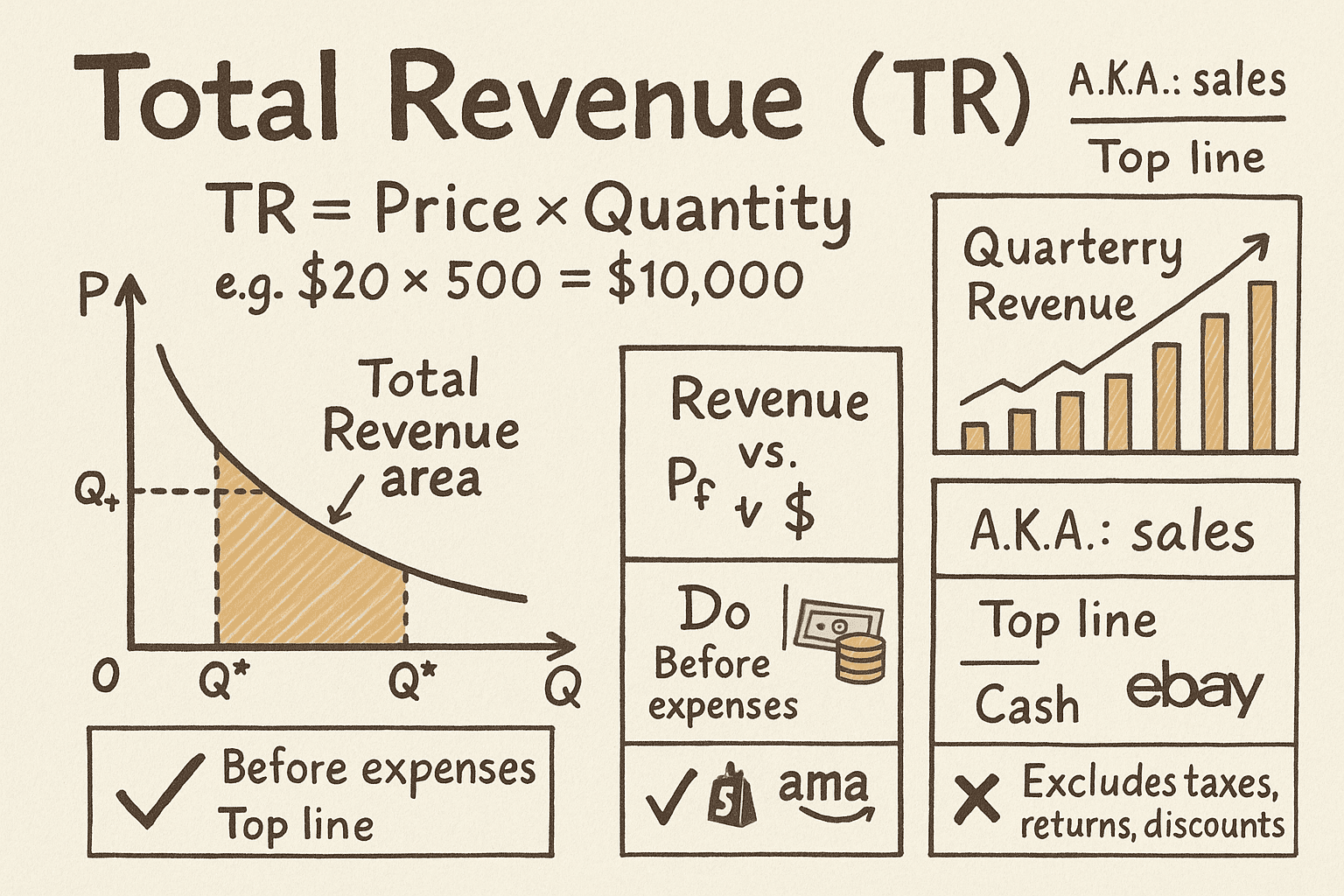
Understanding Total Revenue Position
Visual representation of Total Revenue as the 'top line' in financial statements
This diagram helps visualize the concept of Total Revenue and its fundamental role in financial analysis.
Position of Total Revenue on the Income Statement
On a multi-step income statement, Total Revenue is the first line item, hence the nickname “top line.” It is presented at the very top, before any expenses are listed. An excerpt from Amazon’s financial statements shows “Total Net Sales” (Total Revenue) at the top of the income statement. This is followed by the cost of sales (COGS) and other expenses below, illustrating the top-line placement of revenue. In the example, Amazon’s income statement begins with Total Net Sales of $177.9 billion for the year (broken down into $118.6B product sales and $59.3B service sales) - this number sits at the top of the statement. Every other item on the income statement will be subtracted from or related to this revenue figure in some way.
Immediately beneath the revenue line, companies will list expenses directly related to generating that revenue, starting with Cost of Goods Sold (COGS) (if the company sells products) or sometimes Cost of Sales/Cost of Revenue. By listing revenue first and then subtracting various costs and expenses step by step, the income statement shows how the company’s top-line revenue is whittled down to the bottom-line profit.
It’s worth noting that the income statement can be formatted as single-step or multi-step. In a multi-step income statement (common for most companies), you will see Total Revenue at the top, then COGS, then subtotals like Gross Profit, followed by operating expenses, and so on down to Net Income. In a single-step income statement, revenues might be aggregated together and expenses aggregated together, but even in that case, total revenues would still appear as a separate reported number before a total of all expenses. Thus, regardless of format, Total Revenue is the starting point for the income statement’s calculations.
Role of Total Revenue in Evaluating Business Performance
Total Revenue is a crucial indicator of a company’s size and market activity - it shows how much money the business brought in from selling its goods or services. For many stakeholders, revenue growth is an important sign of a company’s market demand and expansion. A growing revenue trend often indicates the company is selling more products or services (or commanding higher prices), which can imply increased market share or successful business strategies. However, revenue alone does not tell the whole story of performance. Analysts and investors examine revenue in conjunction with other metrics to gauge business health:
- Top-Line Growth vs. Bottom-Line Growth: Revenue is commonly referred to as the “top line,” while Net Income is the “bottom line.” Ideally, a healthy company will grow both its top line (revenue) and bottom line (profit). If revenue is growing, it shows expanding sales; if net income is growing, it shows improving profitability. Sometimes, a company can increase its net income solely by cutting costs even if revenue is flat - but such profit growth may not be sustainable. Investors pay attention to this distinction: if Net Income is rising mainly due to cost cuts while Total Revenue stagnates, it could be a red flag about future growth prospects. Conversely, rapidly rising revenue with persistently low or negative net income might signal that the company is scaling up but needs to control costs or improve margins.
- Indicator of Market Demand: Revenue figures can be used to evaluate a company’s competitive position. For example, comparing year-over-year revenue growth (%) gives a sense of how quickly the company’s sales are expanding. A company outpacing its industry peers in revenue growth may be gaining market share. Investors often look at quarterly revenue and compare it to analyst expectations; companies that beat or miss revenue forecasts can see significant stock price reactions, underscoring how key this metric is.
- Revenue vs. Profitability Metrics: While revenue measures the ability to generate sales, profitability measures like net income or operating income measure the ability to generate profit from those sales. Both are important. For example, a company with $100 million in revenue and $5 million in profit is very different from one with $100 million in revenue and $20 million in profit. Thus, margins (like gross profit margin and net profit margin, which are profit as a percentage of revenue) are often analyzed to assess efficiency and cost management. Still, without sufficient revenue, even the best cost management won’t yield high profits. A balance of strong revenue and controlled expenses is ideal.
- Internal Planning and Analysis: Internally, management uses revenue trends to make strategic decisions - e.g. budgeting for production, marketing, or expansion. Revenue is a key input for many financial analyses and models (including cash flow projections, breakeven analysis, etc.), since it drives how much resource the company has to cover expenses and invest in growth.
In summary, Total Revenue is a vital sign of business performance - often the first number examined in an earnings report - but it must be interpreted alongside cost and profit metrics. A high or growing revenue is generally positive, but how efficiently that revenue turns into profit is equally important. Investors frequently consider revenue and net income separately to get a complete picture of a company’s health: revenue reveals the company’s ability to generate sales, while net income reveals its ability to retain profit after all costs.
Relationship Between Total Revenue and Cost of Goods Sold (COGS)
One of the most immediate relationships on the income statement is between Total Revenue and Cost of Goods Sold (COGS). COGS (sometimes called “cost of sales” or “cost of revenue”) represents the direct costs attributable to producing the goods or services that were sold in the period. For a manufacturing or retail company, this typically includes costs like raw materials, manufacturing labor, and overhead tied to production, or the wholesale cost of goods purchased for resale. For service companies, it may include the direct labor of service providers and any materials used in delivering the service. Here’s how Total Revenue and COGS interact:
- Gross Profit: When you subtract COGS from Total Revenue, you get Gross Profit. This is a key subtotal on a multi-step income statement. Gross Profit = Revenue - COGS. It represents the profit a company makes after covering the direct costs of producing its products/services, but before accounting for operating expenses. A high gross profit indicates that a company is selling its goods/services at a significantly higher price than the cost to produce them (which is generally desirable as it provides more funds to cover other costs). If gross profit is low or declining, it could mean COGS is rising (perhaps due to higher material or labor costs) or pricing is under pressure.
- Gross Margin: Often expressed as a percentage, gross margin = (Gross Profit / Revenue) × 100%. This ratio indicates what portion of revenue is retained as gross profit. It’s directly influenced by the relationship between COGS and revenue. For instance, if COGS increases without a corresponding increase in selling price, gross margin will shrink.
- Income Statement Structure: COGS is typically reported directly below the revenue line on the income statement. By subtracting COGS from revenue, companies present Gross Profit on a separate line. This layout highlights the profitability of the core selling activity before other expenses. The fact that COGS is listed immediately after revenue emphasizes its close connection: Revenue tells us how much was earned from sales; COGS tells us how much it cost to generate those sales. The difference (gross profit) is what’s left to cover all other costs and to provide profit.
- COGS varies with revenue: In many cases, COGS will rise and fall with revenue because it’s often a variable cost. Selling more products usually means higher total COGS (you incur more cost to produce more units). However, companies aim to manage COGS efficiently to maintain healthy gross margins. They might negotiate cheaper input costs, improve manufacturing efficiency, or adjust pricing to ensure revenue grows faster than COGS.
To illustrate, imagine a company has Total Revenue of $1,000,000. If its COGS is $600,000, then Gross Profit is $400,000. If next year revenue grows to $1,200,000 and COGS grows to $750,000, gross profit becomes $450,000. The revenue grew ~20%, but gross profit only grew 12.5%, indicating margins tightened (perhaps due to higher cost per unit or a shift to a less profitable product mix). Analysts would notice that via a gross margin drop (from 40% to 37.5% in this example). This simple example shows why the revenue-COGS relationship is closely watched: it affects how much profit a company can ultimately extract from its sales.
Relationship Between Total Revenue and Net Income
Net Income (or Net Profit), often called the “bottom line,” represents the final profit a company retains after all expenses have been deducted from revenue. It stands in contrast to revenue: Revenue is the gross inflow of funds, whereas Net Income is what’s left as earnings after outflows (expenses) are accounted for. The income statement essentially bridges the gap between the top line (revenue) and bottom line (net income) by subtracting various categories of expenses in between. Here’s how Total Revenue flows through to Net Income:
- Sequential Deduction of Expenses: Starting from Total Revenue, a company subtracts COGS to get gross profit, then subtracts operating expenses (like selling, general & administrative costs, research & development, depreciation, etc.) to get Operating Income (also known as operating profit or EBIT). After that, any non-operating items (such as interest expense, interest income, or one-time gains/losses) are applied, leading to Pre-tax Income. Finally, income taxes are subtracted to arrive at Net Income. In summary: Revenue - COGS - Operating Expenses - Interest/Taxes = Net Income. Net Income is literally “the money that remains from total revenue after a company pays all of its expenses”. This cascading structure shows that if revenue is the starting point, net income is the end point after all deductions.
- Top Line vs. Bottom Line: Revenue and Net Income are distinct but related metrics. As noted, revenue measures ability to generate sales, while net income measures ability to generate profit from those sales. It’s entirely possible for two companies with the same revenue to have very different net incomes, depending on their cost structures. For example, a company with $100 million in revenue could have $10 million in net income (10% net profit margin) while another also with $100 million revenue ends up with only $1 million net income (1% margin) if its expenses are much higher. Thus, Net Income is ultimately dependent on Revenue, but also on how well the company controls costs.
- Net Profit Margin: A useful ratio connecting these two figures is Net Profit Margin = (Net Income / Total Revenue) × 100%. This tells what percentage of each dollar of revenue is translated into profit. It captures both aspects: the top-line prowess (revenue generation) and the cost efficiency. A rising net margin can indicate improving efficiency or a more profitable sales mix; a declining net margin may signal costs growing faster than revenue.
- Scenario analysis: If a company wants to improve net income, there are essentially two levers: increase revenue or decrease expenses (or both). For sustainable growth, companies typically aim to increase revenue (through higher sales volume, new products, pricing power, etc.) while managing expenses. Cutting costs can boost net income in the short term, but as mentioned earlier, if it’s not accompanied by revenue growth, it may not be a positive sign long-term. For instance, a firm that only slashes R&D and marketing to show profit this quarter might harm its future revenue potential.
- Investor perspective: Investors often look at revenue and net income side by side. A healthy company will generally show growth in revenue leading to growth in net income, indicating it can scale its operations profitably. If revenue is growing but net income is not (or is negative), it could mean the company is sacrificing short-term profits to fuel growth (common in startups or growth-stage companies). On the other hand, if net income is growing but revenue is flat, it implies the growth comes solely from cost-cutting or efficiency improvements - which has its limits. Ideally, both top line and bottom line grow in tandem, showing that the company’s core business is expanding and that it’s managed well.
To put it succinctly: Total Revenue is the starting point of profitability, and Net Income is the finish line. Net Income cannot exist without revenue, but high revenue does not automatically guarantee high net income - it must be managed through cost control. This dynamic is why revenue and net income are both reported and analyzed: revenue tells us about the business’s sales strength, and net income tells us about its overall profitability after all pressures.
Industry and Business Model Variations in Reporting Revenue
The concept of “Total Revenue” remains the same in essence across industries - it’s the total income from business operations - but different industries and business models sometimes report revenue in different ways or use different terminology. What counts as revenue, or how it’s presented, can vary depending on the nature of the business. Here are a few examples of how Total Revenue might be reported differently:
- Manufacturing/Retail (Product-Based Businesses): Companies that sell physical goods typically refer to revenue as “Sales” or “Net Sales.” For instance, a retailer or manufacturer will report net sales (after returns/discounts) as the top line. These businesses often show Cost of Goods Sold directly under revenue to highlight gross profit. The term “net sales” implies that things like customer returns and allowances have already been deducted.
- Service Companies: A pure service company (say a consulting firm or a law firm) might label its revenue as “Service Revenue” or just “Revenue.” There is often no physical COGS in the traditional sense; instead, the major costs are salaries of service providers, which might be categorized as operating expenses or as “cost of services.”
- Subscription & SaaS (Software as a Service): Subscription-based businesses often differentiate between recurring revenue (e.g. monthly or annual subscription fees) and non-recurring revenue in their internal metrics. On the income statement, they will usually report a single combined Total Revenue number, sometimes with a breakdown into “subscription revenue” and “professional services revenue”. Investors in SaaS often also look at metrics like Annual Recurring Revenue (ARR), but ARR is not an income statement line item.
- Financial Institutions (Banks): Banks do not have “sales” in the traditional sense. A bank’s revenue largely comes from interest and fees. They typically report interest income and non-interest income. The sum of these is effectively the bank’s Total Revenue. In banking, the interest expense is usually netted against interest income to report Net Interest Income, which becomes a primary component of total revenue.
- Insurance Companies: Insurance firms' primary revenue is premium income. They typically report “Premiums Earned” as their main revenue line. In addition, insurance companies earn significant investment income which is also part of their total revenues. The concept of “net earned premiums” is important: insurers only earn a portion of collected premiums over time.
- Technology and Platform Companies (Marketplace models): Some businesses operate as intermediaries. Accounting rules (principal vs. agent determination) dictate whether they report the gross transaction value as revenue or only the net fees it earns. If the company is an agent, it will only report its commission or fee as revenue (net revenue). If the company is a principal, it reports revenue at gross.
- Terminology Differences: In some sectors, different terms might be used. For example, “Turnover” is commonly used in Europe to mean revenue. In non-profit organizations, they report total revenues which include donations, grants, etc.
In summary, Total Revenue on the income statement is a fundamental figure that anchors financial performance analysis. It is defined consistently as the total earned income from normal business activities, positioned at the top of the income statement, and used to calculate profits by subtracting costs like COGS and other expenses. Its growth (or decline) is a key indicator of business momentum. Furthermore, its relationship with COGS shows how efficiently a company produces its goods, and its relationship with Net Income shows how well a company translates revenue into actual profit. Finally, while the essence of revenue is the same everywhere, the presentation and components of “Total Revenue” can vary across industries - whether it’s called sales, fees, interest income, or premiums - reflecting the diverse ways businesses earn their income. Understanding these nuances allows investors, managers, and students of accounting to better interpret financial statements and gauge a company’s performance in context.
Q&A
Total Revenue is the total income generated from a company's primary business operations before any expenses are deducted, often called the 'top line'.
Official: The sum of all revenue recognized from contracts with customers during a reporting period, net of returns, discounts, and rebates. It excludes non-customer items like interest income or gains. Metaphor: It's the river water that flows in from actual selling—not the rainwater you borrowed from a neighbor (other income).
No. GMV is the total value of transactions on the platform. Total Revenue is usually the platform's net commission (take rate) if it acts as an agent. Metaphor: Think of a toll bridge—GMV is the value of all cars crossing; Total Revenue is just the tolls you collect.
Key Takeaways
Total Revenue is the total income generated from a company's primary business operations before any expenses are deducted, often called the 'top line'.
It is typically reported as 'Net Sales', meaning it is calculated after accounting for customer returns, allowances, and discounts.
Revenue is the starting point of the income statement; subtracting the Cost of Goods Sold (COGS) from revenue yields Gross Profit.
While revenue indicates sales volume and market demand, it does not equal profit. Net Income (the 'bottom line') is what remains after all expenses, including operating costs, interest, and taxes, are subtracted from revenue.
The reporting and components of Total Revenue can vary significantly by industry (e.g., 'premiums' for insurance, 'net interest income' for banks, 'fees' for service firms), so context is crucial for analysis.
Related Terms
Total Revenue
Understanding the 'Top Line' of Financial Performance
Total Revenue (often simply called Revenue or Net Sales) is a fundamental figure on a company's income statement. It represents the total income generated from a company’s core business operations during a specific period, before any expenses are deducted. In other words, it is the sum of all sales of goods and services a company has recognized in that period.
Table of Contents
What Is Total Revenue?
In financial accounting, Total Revenue refers to the aggregate amount of income a company earns from selling its products or services, inclusive of all sales and other revenue streams. It is commonly referred to as the business’s “top line” because it is listed first at the top of the income statement. This top-line number captures the gross earnings of the company before any costs or expenses are subtracted. Total Revenue can encompass various sources of income: for a typical business, it includes product sales and service fees, and may also include any other operating revenues. For instance, a company’s revenue figure might combine sales of physical goods, fees for services rendered, and any other income that is part of its primary operations. Importantly, Total Revenue does not yet account for expenses - those will be deducted further down the income statement to arrive at profit figures.
Key points about Total Revenue:
- It measures the scale of a company's business activity, i.e. how much money the company brought in from its operations in the period.
- It is typically reported net of any sales returns, discounts, or allowances. In practice, companies often use the term “Net Sales” on the income statement, meaning gross sales minus any returns or discounts given to customers.
- It includes only revenues (inflows from customers and other operating sources) and excludes gains from one-time events. One-time gains (like selling an asset) are usually reported separately as other income or gains, not as part of core revenue.
- Total Revenue is not the same as profit; it's a gross figure. All costs (from producing the goods to operating expenses and taxes) have yet to be deducted at this stage.
How Is Total Revenue Calculated?
Calculating Total Revenue is conceptually straightforward: it is the sum of all revenue streams from a company’s business operations. The basic formula can be thought of as:
For a product-based business, revenue is often calculated by multiplying the number of units sold by the average selling price per unit. For example, if a company sells 1,000 widgets at $50 each, its revenue from product sales is $50,000. For a service company, revenue might be calculated as the number of service contracts or customers multiplied by the average fee for the service. In essence, the main component of revenue is the volume of sales times the price per unit or service. However, the real-world calculation of Total Revenue can be more complex and may involve multiple components:
- Multiple products or services: Companies selling different products or services will calculate revenue for each and then sum them to get Total Revenue. For instance, a large company like Amazon reports revenue from “product sales” and “service sales” separately, and then adds them up to a Total Net Sales figure.
- Recurring and one-time revenues: Some businesses (e.g. subscription-based companies) distinguish between recurring revenue (like monthly subscriptions) and one-time or ad-hoc revenues (like one-time setup fees or consulting). Total Revenue would be the sum of all these types of revenue in the period.
- Accrual accounting considerations: Under accrual accounting, revenue is recorded when it is earned (i.e. when goods are delivered or services performed), not necessarily when cash is received. This means Total Revenue includes credit sales (with corresponding accounts receivable on the balance sheet) as long as the earnings process is complete and revenue is recognized according to accounting standards. (For example, if a software company bills a client $120,000 for an annual subscription, it might recognize $10,000 of revenue per month as the service is delivered, rather than the full $120k immediately.)
- Netting of adjustments: As noted, if customers return products or receive rebates/discounts, these are subtracted from gross sales to arrive at the net Revenue figure that appears on the income statement. For example, if gross sales are $100,000 but $5,000 worth of products were returned, the income statement may show net sales of $95,000.
In formula form, many companies compute Net Revenue as:
This net revenue (often just called Total Revenue) is the figure that usually appears at the top of the income statement. It represents what the company effectively earned from sales after adjusting for any price reductions or product returns, providing a realistic view of revenue earned.
Real-World Revenue Calculation Example
Understanding Total Revenue Position
Visual representation of Total Revenue as the 'top line' in financial statements
This diagram helps visualize the concept of Total Revenue and its fundamental role in financial analysis.
Position of Total Revenue on the Income Statement
On a multi-step income statement, Total Revenue is the first line item, hence the nickname “top line.” It is presented at the very top, before any expenses are listed. An excerpt from Amazon’s financial statements shows “Total Net Sales” (Total Revenue) at the top of the income statement. This is followed by the cost of sales (COGS) and other expenses below, illustrating the top-line placement of revenue. In the example, Amazon’s income statement begins with Total Net Sales of $177.9 billion for the year (broken down into $118.6B product sales and $59.3B service sales) - this number sits at the top of the statement. Every other item on the income statement will be subtracted from or related to this revenue figure in some way.
Immediately beneath the revenue line, companies will list expenses directly related to generating that revenue, starting with Cost of Goods Sold (COGS) (if the company sells products) or sometimes Cost of Sales/Cost of Revenue. By listing revenue first and then subtracting various costs and expenses step by step, the income statement shows how the company’s top-line revenue is whittled down to the bottom-line profit.
It’s worth noting that the income statement can be formatted as single-step or multi-step. In a multi-step income statement (common for most companies), you will see Total Revenue at the top, then COGS, then subtotals like Gross Profit, followed by operating expenses, and so on down to Net Income. In a single-step income statement, revenues might be aggregated together and expenses aggregated together, but even in that case, total revenues would still appear as a separate reported number before a total of all expenses. Thus, regardless of format, Total Revenue is the starting point for the income statement’s calculations.
Role of Total Revenue in Evaluating Business Performance
Total Revenue is a crucial indicator of a company’s size and market activity - it shows how much money the business brought in from selling its goods or services. For many stakeholders, revenue growth is an important sign of a company’s market demand and expansion. A growing revenue trend often indicates the company is selling more products or services (or commanding higher prices), which can imply increased market share or successful business strategies. However, revenue alone does not tell the whole story of performance. Analysts and investors examine revenue in conjunction with other metrics to gauge business health:
- Top-Line Growth vs. Bottom-Line Growth: Revenue is commonly referred to as the “top line,” while Net Income is the “bottom line.” Ideally, a healthy company will grow both its top line (revenue) and bottom line (profit). If revenue is growing, it shows expanding sales; if net income is growing, it shows improving profitability. Sometimes, a company can increase its net income solely by cutting costs even if revenue is flat - but such profit growth may not be sustainable. Investors pay attention to this distinction: if Net Income is rising mainly due to cost cuts while Total Revenue stagnates, it could be a red flag about future growth prospects. Conversely, rapidly rising revenue with persistently low or negative net income might signal that the company is scaling up but needs to control costs or improve margins.
- Indicator of Market Demand: Revenue figures can be used to evaluate a company’s competitive position. For example, comparing year-over-year revenue growth (%) gives a sense of how quickly the company’s sales are expanding. A company outpacing its industry peers in revenue growth may be gaining market share. Investors often look at quarterly revenue and compare it to analyst expectations; companies that beat or miss revenue forecasts can see significant stock price reactions, underscoring how key this metric is.
- Revenue vs. Profitability Metrics: While revenue measures the ability to generate sales, profitability measures like net income or operating income measure the ability to generate profit from those sales. Both are important. For example, a company with $100 million in revenue and $5 million in profit is very different from one with $100 million in revenue and $20 million in profit. Thus, margins (like gross profit margin and net profit margin, which are profit as a percentage of revenue) are often analyzed to assess efficiency and cost management. Still, without sufficient revenue, even the best cost management won’t yield high profits. A balance of strong revenue and controlled expenses is ideal.
- Internal Planning and Analysis: Internally, management uses revenue trends to make strategic decisions - e.g. budgeting for production, marketing, or expansion. Revenue is a key input for many financial analyses and models (including cash flow projections, breakeven analysis, etc.), since it drives how much resource the company has to cover expenses and invest in growth.
In summary, Total Revenue is a vital sign of business performance - often the first number examined in an earnings report - but it must be interpreted alongside cost and profit metrics. A high or growing revenue is generally positive, but how efficiently that revenue turns into profit is equally important. Investors frequently consider revenue and net income separately to get a complete picture of a company’s health: revenue reveals the company’s ability to generate sales, while net income reveals its ability to retain profit after all costs.
Relationship Between Total Revenue and Cost of Goods Sold (COGS)
One of the most immediate relationships on the income statement is between Total Revenue and Cost of Goods Sold (COGS). COGS (sometimes called “cost of sales” or “cost of revenue”) represents the direct costs attributable to producing the goods or services that were sold in the period. For a manufacturing or retail company, this typically includes costs like raw materials, manufacturing labor, and overhead tied to production, or the wholesale cost of goods purchased for resale. For service companies, it may include the direct labor of service providers and any materials used in delivering the service. Here’s how Total Revenue and COGS interact:
- Gross Profit: When you subtract COGS from Total Revenue, you get Gross Profit. This is a key subtotal on a multi-step income statement. Gross Profit = Revenue - COGS. It represents the profit a company makes after covering the direct costs of producing its products/services, but before accounting for operating expenses. A high gross profit indicates that a company is selling its goods/services at a significantly higher price than the cost to produce them (which is generally desirable as it provides more funds to cover other costs). If gross profit is low or declining, it could mean COGS is rising (perhaps due to higher material or labor costs) or pricing is under pressure.
- Gross Margin: Often expressed as a percentage, gross margin = (Gross Profit / Revenue) × 100%. This ratio indicates what portion of revenue is retained as gross profit. It’s directly influenced by the relationship between COGS and revenue. For instance, if COGS increases without a corresponding increase in selling price, gross margin will shrink.
- Income Statement Structure: COGS is typically reported directly below the revenue line on the income statement. By subtracting COGS from revenue, companies present Gross Profit on a separate line. This layout highlights the profitability of the core selling activity before other expenses. The fact that COGS is listed immediately after revenue emphasizes its close connection: Revenue tells us how much was earned from sales; COGS tells us how much it cost to generate those sales. The difference (gross profit) is what’s left to cover all other costs and to provide profit.
- COGS varies with revenue: In many cases, COGS will rise and fall with revenue because it’s often a variable cost. Selling more products usually means higher total COGS (you incur more cost to produce more units). However, companies aim to manage COGS efficiently to maintain healthy gross margins. They might negotiate cheaper input costs, improve manufacturing efficiency, or adjust pricing to ensure revenue grows faster than COGS.
To illustrate, imagine a company has Total Revenue of $1,000,000. If its COGS is $600,000, then Gross Profit is $400,000. If next year revenue grows to $1,200,000 and COGS grows to $750,000, gross profit becomes $450,000. The revenue grew ~20%, but gross profit only grew 12.5%, indicating margins tightened (perhaps due to higher cost per unit or a shift to a less profitable product mix). Analysts would notice that via a gross margin drop (from 40% to 37.5% in this example). This simple example shows why the revenue-COGS relationship is closely watched: it affects how much profit a company can ultimately extract from its sales.
Relationship Between Total Revenue and Net Income
Net Income (or Net Profit), often called the “bottom line,” represents the final profit a company retains after all expenses have been deducted from revenue. It stands in contrast to revenue: Revenue is the gross inflow of funds, whereas Net Income is what’s left as earnings after outflows (expenses) are accounted for. The income statement essentially bridges the gap between the top line (revenue) and bottom line (net income) by subtracting various categories of expenses in between. Here’s how Total Revenue flows through to Net Income:
- Sequential Deduction of Expenses: Starting from Total Revenue, a company subtracts COGS to get gross profit, then subtracts operating expenses (like selling, general & administrative costs, research & development, depreciation, etc.) to get Operating Income (also known as operating profit or EBIT). After that, any non-operating items (such as interest expense, interest income, or one-time gains/losses) are applied, leading to Pre-tax Income. Finally, income taxes are subtracted to arrive at Net Income. In summary: Revenue - COGS - Operating Expenses - Interest/Taxes = Net Income. Net Income is literally “the money that remains from total revenue after a company pays all of its expenses”. This cascading structure shows that if revenue is the starting point, net income is the end point after all deductions.
- Top Line vs. Bottom Line: Revenue and Net Income are distinct but related metrics. As noted, revenue measures ability to generate sales, while net income measures ability to generate profit from those sales. It’s entirely possible for two companies with the same revenue to have very different net incomes, depending on their cost structures. For example, a company with $100 million in revenue could have $10 million in net income (10% net profit margin) while another also with $100 million revenue ends up with only $1 million net income (1% margin) if its expenses are much higher. Thus, Net Income is ultimately dependent on Revenue, but also on how well the company controls costs.
- Net Profit Margin: A useful ratio connecting these two figures is Net Profit Margin = (Net Income / Total Revenue) × 100%. This tells what percentage of each dollar of revenue is translated into profit. It captures both aspects: the top-line prowess (revenue generation) and the cost efficiency. A rising net margin can indicate improving efficiency or a more profitable sales mix; a declining net margin may signal costs growing faster than revenue.
- Scenario analysis: If a company wants to improve net income, there are essentially two levers: increase revenue or decrease expenses (or both). For sustainable growth, companies typically aim to increase revenue (through higher sales volume, new products, pricing power, etc.) while managing expenses. Cutting costs can boost net income in the short term, but as mentioned earlier, if it’s not accompanied by revenue growth, it may not be a positive sign long-term. For instance, a firm that only slashes R&D and marketing to show profit this quarter might harm its future revenue potential.
- Investor perspective: Investors often look at revenue and net income side by side. A healthy company will generally show growth in revenue leading to growth in net income, indicating it can scale its operations profitably. If revenue is growing but net income is not (or is negative), it could mean the company is sacrificing short-term profits to fuel growth (common in startups or growth-stage companies). On the other hand, if net income is growing but revenue is flat, it implies the growth comes solely from cost-cutting or efficiency improvements - which has its limits. Ideally, both top line and bottom line grow in tandem, showing that the company’s core business is expanding and that it’s managed well.
To put it succinctly: Total Revenue is the starting point of profitability, and Net Income is the finish line. Net Income cannot exist without revenue, but high revenue does not automatically guarantee high net income - it must be managed through cost control. This dynamic is why revenue and net income are both reported and analyzed: revenue tells us about the business’s sales strength, and net income tells us about its overall profitability after all pressures.
Industry and Business Model Variations in Reporting Revenue
The concept of “Total Revenue” remains the same in essence across industries - it’s the total income from business operations - but different industries and business models sometimes report revenue in different ways or use different terminology. What counts as revenue, or how it’s presented, can vary depending on the nature of the business. Here are a few examples of how Total Revenue might be reported differently:
- Manufacturing/Retail (Product-Based Businesses): Companies that sell physical goods typically refer to revenue as “Sales” or “Net Sales.” For instance, a retailer or manufacturer will report net sales (after returns/discounts) as the top line. These businesses often show Cost of Goods Sold directly under revenue to highlight gross profit. The term “net sales” implies that things like customer returns and allowances have already been deducted.
- Service Companies: A pure service company (say a consulting firm or a law firm) might label its revenue as “Service Revenue” or just “Revenue.” There is often no physical COGS in the traditional sense; instead, the major costs are salaries of service providers, which might be categorized as operating expenses or as “cost of services.”
- Subscription & SaaS (Software as a Service): Subscription-based businesses often differentiate between recurring revenue (e.g. monthly or annual subscription fees) and non-recurring revenue in their internal metrics. On the income statement, they will usually report a single combined Total Revenue number, sometimes with a breakdown into “subscription revenue” and “professional services revenue”. Investors in SaaS often also look at metrics like Annual Recurring Revenue (ARR), but ARR is not an income statement line item.
- Financial Institutions (Banks): Banks do not have “sales” in the traditional sense. A bank’s revenue largely comes from interest and fees. They typically report interest income and non-interest income. The sum of these is effectively the bank’s Total Revenue. In banking, the interest expense is usually netted against interest income to report Net Interest Income, which becomes a primary component of total revenue.
- Insurance Companies: Insurance firms' primary revenue is premium income. They typically report “Premiums Earned” as their main revenue line. In addition, insurance companies earn significant investment income which is also part of their total revenues. The concept of “net earned premiums” is important: insurers only earn a portion of collected premiums over time.
- Technology and Platform Companies (Marketplace models): Some businesses operate as intermediaries. Accounting rules (principal vs. agent determination) dictate whether they report the gross transaction value as revenue or only the net fees it earns. If the company is an agent, it will only report its commission or fee as revenue (net revenue). If the company is a principal, it reports revenue at gross.
- Terminology Differences: In some sectors, different terms might be used. For example, “Turnover” is commonly used in Europe to mean revenue. In non-profit organizations, they report total revenues which include donations, grants, etc.
In summary, Total Revenue on the income statement is a fundamental figure that anchors financial performance analysis. It is defined consistently as the total earned income from normal business activities, positioned at the top of the income statement, and used to calculate profits by subtracting costs like COGS and other expenses. Its growth (or decline) is a key indicator of business momentum. Furthermore, its relationship with COGS shows how efficiently a company produces its goods, and its relationship with Net Income shows how well a company translates revenue into actual profit. Finally, while the essence of revenue is the same everywhere, the presentation and components of “Total Revenue” can vary across industries - whether it’s called sales, fees, interest income, or premiums - reflecting the diverse ways businesses earn their income. Understanding these nuances allows investors, managers, and students of accounting to better interpret financial statements and gauge a company’s performance in context.
Q&A
Total Revenue is the total income generated from a company's primary business operations before any expenses are deducted, often called the 'top line'.
Official: The sum of all revenue recognized from contracts with customers during a reporting period, net of returns, discounts, and rebates. It excludes non-customer items like interest income or gains. Metaphor: It's the river water that flows in from actual selling—not the rainwater you borrowed from a neighbor (other income).
No. GMV is the total value of transactions on the platform. Total Revenue is usually the platform's net commission (take rate) if it acts as an agent. Metaphor: Think of a toll bridge—GMV is the value of all cars crossing; Total Revenue is just the tolls you collect.
Key Takeaways
Total Revenue is the total income generated from a company's primary business operations before any expenses are deducted, often called the 'top line'.
It is typically reported as 'Net Sales', meaning it is calculated after accounting for customer returns, allowances, and discounts.
Revenue is the starting point of the income statement; subtracting the Cost of Goods Sold (COGS) from revenue yields Gross Profit.
While revenue indicates sales volume and market demand, it does not equal profit. Net Income (the 'bottom line') is what remains after all expenses, including operating costs, interest, and taxes, are subtracted from revenue.
The reporting and components of Total Revenue can vary significantly by industry (e.g., 'premiums' for insurance, 'net interest income' for banks, 'fees' for service firms), so context is crucial for analysis.
Related Terms
Apply This Knowledge
Ready to put Total Revenue into practice? Use our tools to analyze your portfolio and explore market opportunities.
This content is also available on our main website for public access.